
Metals Tempers Chart

Why Metal Temper Codes Matter
Understanding metal temper codes is the difference between a project that holds up and one that fails under stress. Whether you are engineering a structural framework or selecting materials for precision machining, you need to know exactly what the alphanumeric suffixes on your material list mean. Use this guide to decode industry-standard designations or contact Warrenton Steel today to verify our current inventory of certified metals.
The "Decoder": Mastering Metal Temper Codes
The metal temper designation chart acts as the "key" to reading the code of material properties. Users searching for these terms often need to translate complex specifications into purchasing decisions. The system differentiates based on how the metal achieves its strength. For aluminum, the temper codes meaning is complex, distinguishing between thermal treatments (T) and strain hardening (H). In contrast, the steel temper rating scale often relies on terms like "annealed" or "full hard," while heat treatment temper codes define the exact process used to alter the microstructure. Understanding the hardness vs temper chart ensures you select a material that balances yield strength with ductility.
| Copper, Brass, and Bronze | ||
|---|---|---|
| Temper | Description | When Is It Used? |
| O60 | Annealed | Applications that require ease of forming and bending. |
| H00 | 1/8 Hard | Forming applications where more resistance to the stresses of expansion and contraction are required. |
| H01 | ¼ Hard | Applications where strength and malleability are both important. |
| H02 | ½ Hard | Most construction applications where strength is most important. |
| H04 | Full Hard | Round bar stock where high strength is required. |
| H58 | Drawn General Purpose | General purpose tube where strength and hardness are not required. |
| H80 | Hard Drawn | High pressure tube applications and where strength is required. |
| M07 | As-continuous cast | A better quality more cost effective cast bar product that requires machining to finished dimensions. |
| M20 | As-hot rolled | Manufactured temper for hot worked bar and plate. |
| M30 | As-hot extruded | Manufactured temper for hot extruded shapes. |
Aluminum Temper Designations Explained
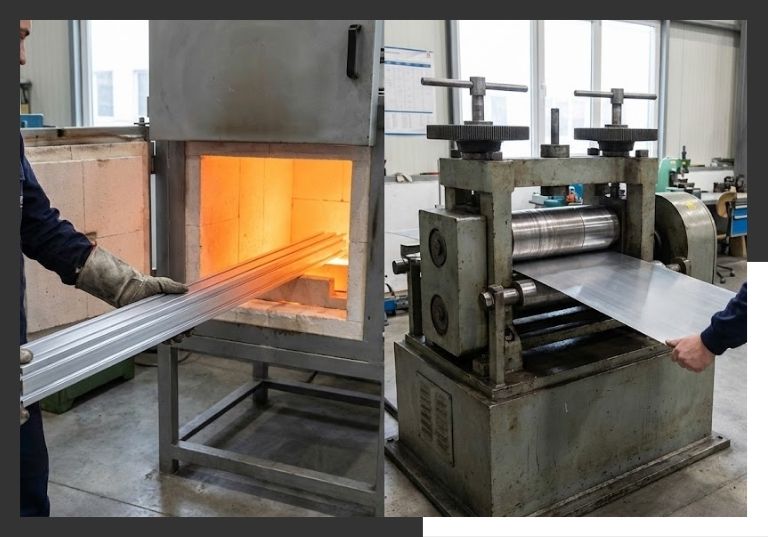
Aluminum uses the most intricate system, driving the most traffic for users trying to decipher codes. The most common questions revolve around the "T" series (thermally treated) and "H" series (strain hardened). For example, 6061-T6 properties indicate the alloy has been solution heat-treated and artificially aged for maximum strength, whereas T4 is naturally aged, offering better formability but lower strength. In the "H" series, 5052-H32 temper meaning refers to a material that is strain-hardened and then stabilized (H3x) to prevent age-softening. Understanding these nuances helps you avoid specifying a brittle alloy for a project requiring bending.
Stainless and Carbon Steel Temper Ratings
Steel tempers generally refer to the degree of cold rolling and annealing. In stainless steel, designations like quarter hard vs half hard quantify the increase in tensile strength achieved through cold working; "full hard" represents the maximum tensile strength, while annealed offers the softest state for deep drawing. Cold-rolled steel tempers are critical for stamping applications where spring-back must be calculated. Additionally, "spring temper steel hardness" refers to steel rolled or heat-treated to a high yield strength, allowing it to return to its original shape after significant deflection—a crucial property for clips, springs, and fasteners.

Copper and Brass Hardness Properties
Copper and brass alloys utilize a mix of H-series codes and descriptive hardness terms. A frequent comparison is half-hard brass properties versus harder tempers. For copper, designations like H02 (half hard) vs H04 (hard) dictate the material's formability and electrical performance. H02 is often preferred when the material must be bent or formed without cracking, whereas H04 provides rigidity for contact points or structural components. Selecting the right temper ensures that decorative brass or conductive copper components perform mechanically without sacrificing their essential material characteristics.
Understanding Melting Points of Metal
While temper defines hardness and strength, the melting point determines high-temperature viability and welding procedures. Carbon Steel generally melts around 2600-2800°F, whereas aluminum has a much lower melting point of approximately 1220°F. This drastic difference explains why welding aluminum requires different techniques (like AC TIG) compared to steel. Knowledge of melting points is non-negotiable when designing assemblies exposed to heat or when selecting brazing and soldering alloys for mixed-metal fabrication.
Critical Comparisons: Which One Do I Pick?
Engineers often face difficult choices when specifications overlap. Here is how to distinguish between common temperaments:
- T6 vs T651 difference: While both are heat-treated, T651 is stress-relieved by stretching. This is vital for machining, as T651 will not warp as much as standard T6 when material is removed.
- T3 vs T4 aluminum: T3 is solution heat-treated, cold worked, and naturally aged (common in aerospace), while T4 is only solution heat-treated and naturally aged.
- H14 vs H32 temper: H14 is strain-hardened only, while H32 is strain-hardened and then low-temperature stabilized to improve ductility.
- Dead Soft vs Annealed: "Dead soft" usually implies the absolute softest condition possible for maximum malleability, often utilized in copper gaskets, while "annealed" is a broader term for softened metal.
- F temper vs O temper: "F" stands for "As fabricated" with no control over thermal or work-hardening conditions. "O" temper signifies the material has been fully annealed and recrystallized to its lowest strength and highest ductility.
Common Questions About Metal Tempers (FAQ)
Does a higher temper number mean harder?
For the "H" (strain-hardened) series, yes—H38 is significantly harder than H32. However, for "T" (heat-treated) tempers, higher numbers denote different processes, not necessarily hardness (e.g., T7 is often softer than T6 due to over-aging).
Is T6 harder than T5?
Yes. T6 involves a full solution heat treatment and artificial aging for maximum strength. T5 skips the solution treatment, cooling directly from shaping (like extrusion), resulting in lower strength but faster production.
What does the T mean in aluminum?
It stands for "thermally treated." It designates alloys that require heat application (baking) to achieve their properties, followed by digits (T1–T10) indicating the specific heating and cooling sequence.
Difference between heat-treated and strain-hardened?
Heat treating strengthens metal by chemically altering the internal microstructure via temperature. Strain hardening strengthens metal physically by deforming and compressing the grain structure (cold working).
How to read aluminum temper codes?
It is a hierarchy: The letter (F, O, H, W, T) defines the method. The first digit defines the process variation (e.g., H3 = stabilized). The second digit defines the hardness scale (e.g., 2=1/4 hard, 8=full hard).
Get the Right Temper
for Your NExt Project
Navigating specific temper codes requires a partner who understands the science behind the supply. Warrenton Steel provides the expertise to ensure you get the exact grade and temper for your application. Don't risk structural failure with the wrong specification. Call us today to discuss your project requirements with our experts.
Sign Up For Our Newsletter
Get invaluable insight sent directly to your inbox!